FROM SIGNAL TO SYSTEM | FOCUS PERSPECTIVE
ThynkTerra Systems | 15 November 2026
While studying neurology during my Step 1 preparation, I found myself thinking about the blood-brain barrier not only as an exam concept, but as a real scientific design challenge: how do we get the right therapeutic message to the right cells, and know that it actually works once it arrives? That reflection made a new study on brain-directed RNA delivery feel especially timely—and it points directly toward the kind of chemistry, computation, AI, and targeted-delivery questions ThynkTerra is beginning to build into its scientific identity.
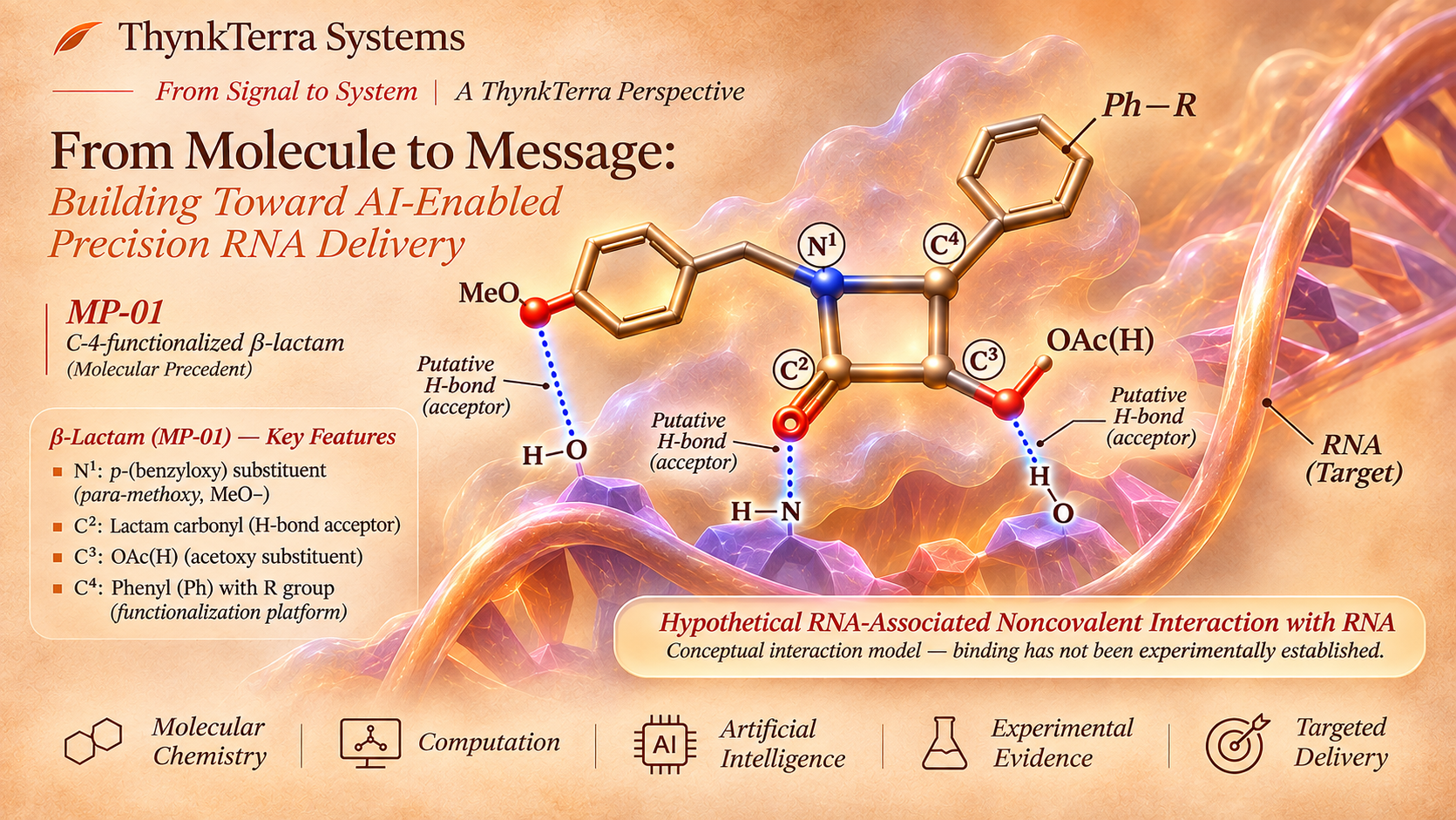
Hypothetical RNA-associated noncovalent interaction with RNA. Conceptual interaction model — binding has not been experimentally established.
THE SIGNAL
That question followed me out of my neurology study session and into the scientific literature. One paper in particular made me stop and think: what if a medicine already known to act in the central nervous system could offer clues for designing a better delivery vehicle—not as the treatment itself, but as a starting point for carrier chemistry?
A study published in Nature Nanotechnology on 3 November 2026 explored this idea. Researchers examined the pharmaceutical profiles of more than 100 central-nervous-system-active drugs and selected hydroxyzine as a promising molecular scaffold for designing ionizable lipids. One resulting lipid nanoparticle formulation, HX1, supported messenger RNA (mRNA) delivery to the brain through several transport pathways across central nervous system barriers.
The experimental results went beyond detecting carrier-associated material in brain tissue. In mice, HX1 nanoparticles co-delivered CRISPR-related RNA components and enabled brain gene editing. In another mouse experiment, particles containing interleukin-10 (IL-10) mRNA reduced radiation-induced brain injury. The team also demonstrated delivery of luciferase-reporter mRNA to the brain of a non-human primate. These are important preclinical findings, not demonstrations of therapeutic efficacy or safety in humans.
Two near-contemporaneous reviews sharpen the context. A Molecular Pharmaceutics review published on 7 November emphasizes that brain-directed RNA therapy faces barriers after entry into the central nervous system: tissue distribution, uptake by the intended cells, and successful delivery of RNA inside those cells. A Journal of Controlled Release review published on 5 November addresses a complementary translational challenge: computational tools and AI can assist nanomedicine design and manufacturing, but model reliability, data quality, and mechanistic validation remain limiting factors.
WHY IT MATTERS
For many RNA therapies, the central challenge is not designing the message. It is getting the message to a place where a cell can use it.
RNA is vulnerable to degradation, does not readily pass through cell membranes, and must reach an appropriate intracellular compartment to function. The blood–brain barrier adds an especially selective interface between circulation and neural tissue. Carriers that perform well in one organ or cell model may behave differently elsewhere.
This creates an easily overlooked distinction between three kinds of success: a carrier reaches the brain; the intended cells receive usable RNA; and the RNA produces a beneficial biological effect without unacceptable harm.
Those outcomes are related, but they are not interchangeable. A strong signal in brain tissue does not, by itself, prove selective delivery to neurons or other target cells. Evidence of RNA expression does not automatically demonstrate a durable therapeutic benefit. And a successful result in an animal model does not establish that a carrier will behave the same way in people.
The November study is compelling because it connects a chemical design hypothesis to several functional tests. The broader opportunity is to make this level of connection routine rather than exceptional.
THE SYSTEM BEHIND IT
A drug-delivery system can be understood as a series of selective handoffs.
First, molecular design. The chemical identity of an ionizable lipid influences how it packages RNA, interacts with biological fluids, responds to changes in pH, and interacts with cell membranes. Selecting a scaffold from a central-nervous-system-active compound is a source of design hypotheses, not a guarantee that the newly synthesized carrier retains the original drug's pharmacology or safety profile.
Second, transport and distribution. After administration, a formulation must survive its route through the body, avoid premature loss of cargo, and encounter the appropriate tissue. In brain delivery, passage across one interface is only one step among several.
Third, cellular access. A nanoparticle may enter an organ without delivering its cargo to the particular cell types needed for treatment. Uptake alone is insufficient if the RNA remains trapped in intracellular vesicles.
Fourth, functional release and response. The RNA must become available to the cell's machinery and generate the intended biological activity—protein expression, gene regulation, or gene editing—at a meaningful level.
Fifth, translation. Repeated-dose tolerability, inflammatory responses, off-target exposure, reproducible manufacturing, formulation stability, and clinically relevant dose requirements all matter before a promising carrier can become a medicine.
A useful development program therefore needs measurements that span the entire chain rather than relying on one attractive biodistribution image or reporter endpoint.
THE THYNKTERRA PERSPECTIVE
The most useful idea emerging from this research is that the carrier has a biological identity of its own.
It is tempting to think of a lipid nanoparticle as protective packaging for a sophisticated RNA payload. In practice, the carrier's chemistry influences where the payload travels, how it enters cells, and whether the cargo can function. The delivery vehicle is therefore part of the therapeutic design—not a neutral container added at the end.
The hydroxyzine-informed HX1 work offers one example of how existing pharmacological knowledge can guide new materials research. It should not be read as evidence that hydroxyzine itself treats brain disease through this formulation, or that a chemical resemblance makes the new material clinically safe. Rather, the study illustrates the value of starting from a biologically informed chemical hypothesis and testing what the redesigned material actually does.
This matters for the future of AI-assisted formulation as well. Models can help identify promising structures and reduce experimental search, but only when the data capture relevant biological outcomes. Predicting a particle's size, for example, is a different task from predicting functional RNA expression in a particular brain cell under tolerable exposure conditions.
At ThynkTerra Systems, we view precision delivery as a systems problem. Meaningful progress requires chemistry, biological transport, cellular mechanisms, controlled release, evidence quality, and manufacturing to be evaluated together. The research question is not simply, “Did the particle arrive?” It is, “What useful action followed its arrival—and under what conditions?”
FROM MOLECULAR PRECEDENT TO AN EMERGING RESEARCH IDENTITY
This systems view of drug delivery also reflects the scientific direction ThynkTerra Systems is beginning to build. For me, this is one of the destinations I see for ThynkTerra as we continue to grow. We see our emerging research identity at the intersection of molecular chemistry, computational science, artificial intelligence, and targeted drug delivery. Rather than beginning with AI as an end in itself, we want to build from rigorous molecular understanding and progressively develop the computational and data-driven tools needed to address more complex delivery questions.
Our first step in that direction is what we call Molecular Precedent 01, or MP-01: a C-4-functionalized β-lactam reference system. MP-01 is not being presented as an RNA carrier, targeting ligand, or therapeutic platform. Nor do we claim that the full computational and AI framework has already been validated. Instead, it represents the molecular system through which we intend to develop that capability—learning how to move carefully from structure and stereochemistry to computation, molecular descriptors, AI-assisted analysis, uncertainty assessment, and evidence-based experimental decisions.
The longer-term vision is to transfer what is learned from this molecular precedent into increasingly complex drug-targeting and delivery programs, where therapeutic cargo, carrier chemistry, biological targeting, controlled release, safety, and manufacturability must be considered together. For RNA delivery, that future design space may include ionizable-lipid chemistry, particle characteristics, ligand presentation, cargo properties, cellular uptake, endosomal escape, cell specificity, and functional expression. In that emerging model, AI is not the identity by itself. It is one component of a larger scientific system.
For ThynkTerra, the direction is clear: chemistry establishes the foundation; computation expands what can be examined; AI helps determine what may be worth testing next; and experiment ultimately decides what is real. This is the scientific capability ThynkTerra is working to build.
WHAT TO WATCH
Cell-specific delivery. Future studies should clarify which brain cell populations receive functional cargo, and whether targeting holds across different biological contexts.
Reproducibility across species. Non-human-primate reporter delivery is a notable step, but larger and independently replicated studies are needed to understand dose-response relationships and whether preclinical findings translate to people.
Safety over time. Acute tolerability and short-term experimental results cannot resolve long-term effects, repeated-dose immune responses, or unintended gene-editing activity.
Manufacturing and formulation robustness. A useful carrier must retain consistent composition, RNA integrity, particle characteristics, and biological performance as production methods and scales change.
More informative computational design. AI and predictive models will be most valuable when they optimize functional outcomes and uncertainty—not just convenient material descriptors—and when their predictions are tested with rigorous experiments.
The advance worth watching is not the promise of a single brain-targeting particle. It is the emergence of more disciplined ways to connect chemical structure to biological delivery and, eventually, patient benefit.
Precision delivery begins with a precise definition of what successful delivery means.
Sources and further reading
1. Tian, M., Wang, L., Liu, Z., et al. Rational design of lipid nanoparticles for brain delivery of RNA therapeutics. Nature Nanotechnology. Published 3 November 2026. DOI: 10.1038/s41565-026-02326-7.
https://pubmed.ncbi.nlm.nih.gov/42977805/
https://doi.org/10.1038/s41565-026-02326-7
2. Magaw, M., Narasipura, E. A., VanKeulen-Miller, R., and Fenton, O. S. Lipid Nanoparticles for RNA Delivery to the Central Nervous System: Biological Barriers, Engineering Strategies, and Therapeutic Applications. Molecular Pharmaceutics. Published online 7 November 2026. DOI: 10.1021/acs.molpharmaceut.6c01318.
https://doi.org/10.1021/acs.molpharmaceut.6c01318
3. Wang, L., Jin, Y., Sun, L., et al. Artificial intelligence-enabled nanomedicine development: From rational design to manufacturing optimization. Journal of Controlled Release. Published 5 November 2026. DOI: 10.1016/j.jconrel.2026.115531.
https://pubmed.ncbi.nlm.nih.gov/42988057/
4. Arral, M. L. and Whitehead, K. A. Design principles of lipid nanoparticles for RNA delivery. Nature Reviews Bioengineering. Published 2 February 2026. DOI: 10.1038/s44222-026-00401-1.